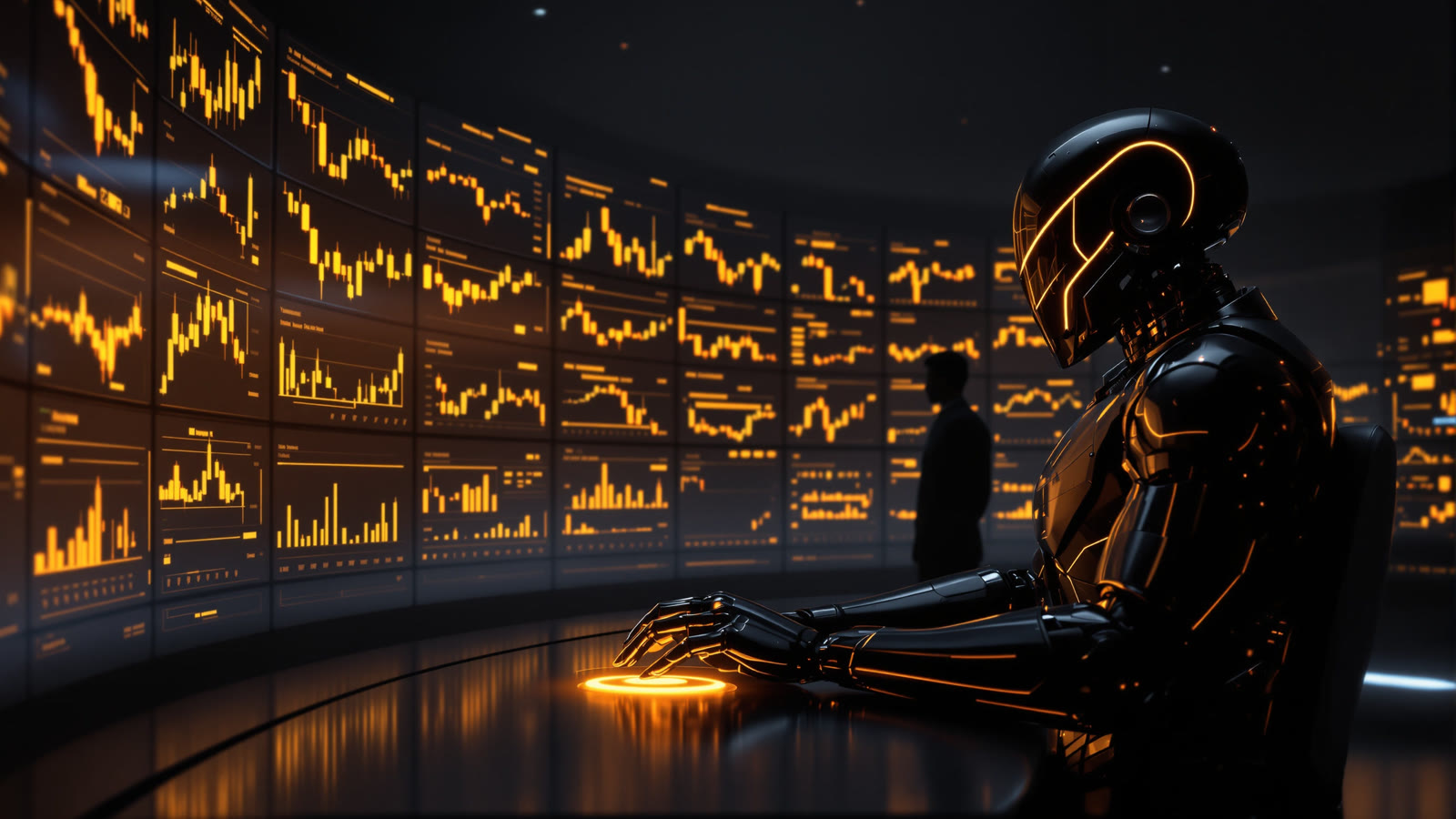
In the space of a few weeks, three of the biggest names in money opened their doors to AI agents. Robinhood is building an AI into its app that can trade for you around the clock. Coinbase now lets AI agents trade futures. Mastercard is testing payments made by machines to machines.
The pitch is simple: let the AI do the work. The question nobody is shouting about is simpler still: when the agent loses your money, who pays?
The answer is in the fine print. And it is you.
What Robinhood announced
At its HOOD Summit, Robinhood unveiled **Robinhood Agents**: AI agents built into the app that can analyse the market, build a strategy and place trades without you leaving Robinhood. You pick the model from several AI labs, OpenAI among them. A feature called **Loops**, "coming soon", will let you set standing instructions that the agent carries out over and over, even while you are away.
Some numbers Robinhood gave:
- **More than 150,000 customers** have opened agentic trading accounts since agentic trading launched in May. - Agents use Robinhood's tools **almost 30 million times a day**. - Robinhood Agents are "coming soon to eligible U.S. customers".
There are guardrails. Every agent works in a **separate agentic account** and can only touch the money in it. It trades within the limits you set. And **manual approval is on by default**: the agent drafts a trade, you confirm it.
But you can switch approval off. Then the agent places orders without asking. And Loops may place, change or cancel trades automatically, with no approval per trade.
The line that matters most
Here is the sentence from Robinhood's own disclosures that deserves to be on the front page: Robinhood says it **does not control, supervise, monitor, recommend or audit the agents**, and that **users assume all risk** for trades executed by AI agents.
Read that twice. The platform gives you the agent, the account and the button. The losses are yours.
Coinbase and Mastercard are moving too
- On 21 October **Coinbase for Agents**, which already lets AIs such as Claude and ChatGPT trade inside a Coinbase Advanced Trade account within limits the user sets, enabled **perpetual futures**: more than 20 crypto tokens plus US index contracts such as US500, AI10 and TECH100 (the index contracts are US-only). The detail that went viral: a user's agent asked for the feature through a feedback command, Coinbase's own agent turned the request into code, and it was **approved and live about five minutes later**. - On 20 October **Mastercard** opened early access to **Agent Pay for Machines**, APIs that let AI agents pay and get paid, after pilots with Cloudflare, Ant International, BVNK, AIsa, Base and Coinbase. It is still a pilot, not a commercial product.
Futures are leveraged products. Machines paying machines means money moving without a human in each step. The direction is clear.
Meanwhile, the banks are slamming the door
Not everyone agrees. JPMorgan currently blocks outside AI agents from acting for its retail customers: they can read some data, such as balances, but cannot move money. Charles Schwab blocks outside agents that try to move client money and points them to tools that can only read and research. Schwab's CEO put the problem in one line: if something goes wrong, who is liable?
So the same week, one part of finance says "let the AI trade" and another says "not with our customers' money". Both are reacting to the same risk.
What happens when an AI actually trades
Stark Insider ran a small public experiment this month: two AI agents, **$500 of real money each**, picking AI and tech stocks for October. After ten trading days one agent was **down 12.4%** (it had been up 4.7% at its peak), the other **down 10.2%**. The test ran straight into the week when AI and chip stocks lost more than $1 trillion.
It is a tiny sample, and the experiment is not over. But it shows the point well: an agent does not make a falling market safer. It just trades faster.
Before you let an AI trade for you
If you try any of these tools, a few questions are worth asking first:
1. **Is manual approval on?** Keep it on until you have watched the agent for a while. 2. **How much can it touch?** Put only what you can afford to lose in the agent's account. 3. **Can it withdraw?** A trading permission should never include moving money out. 4. **What are its limits?** A maximum per trade, a daily stop, an automatic shutdown after a drawdown. 5. **Can you see every trade?** If you cannot see what the agent did and why, you cannot judge it. 6. **Who pays if it goes wrong?** Read the disclosures. Usually the answer is: you.
How we do it at NeuPortal
We build AI agents that trade real markets, so we have thought about this question more than most. Our answer is to take away the dark room: our AI trades **on a live stream, every trade on screen**, wins and losses included, and we publish our forecasts before the event and score them in public against the market. You can watch it work before you trust it with anything: neuportal.ai
The bottom line
AI agents that trade and pay for you are no longer a demo. Robinhood, Coinbase and Mastercard are opening the doors, while JPMorgan and Schwab keep theirs shut. The technology is moving faster than the rules about who carries the risk. Until that changes, the fine print is clear: the agent trades, and you take the loss.
**NeuPortal is building exactly this.** Our team develops AI trading agents that work in the open, with every trade on screen and every forecast scored in public. We will present our products to the world very soon, on 5 November. Save your spot at neuportal.ai and be among the first to see them.
Discuss it with us in the Telegram community: t.me/neuportal_community
*Not financial advice. Sources: Robinhood newsroom (HOOD Summit 2026), Crypto Briefing (21 October 2026), The Block (20 October 2026), Stark Insider (19 October 2026), reporting on JPMorgan and Schwab from Cybernews and American Banker.*