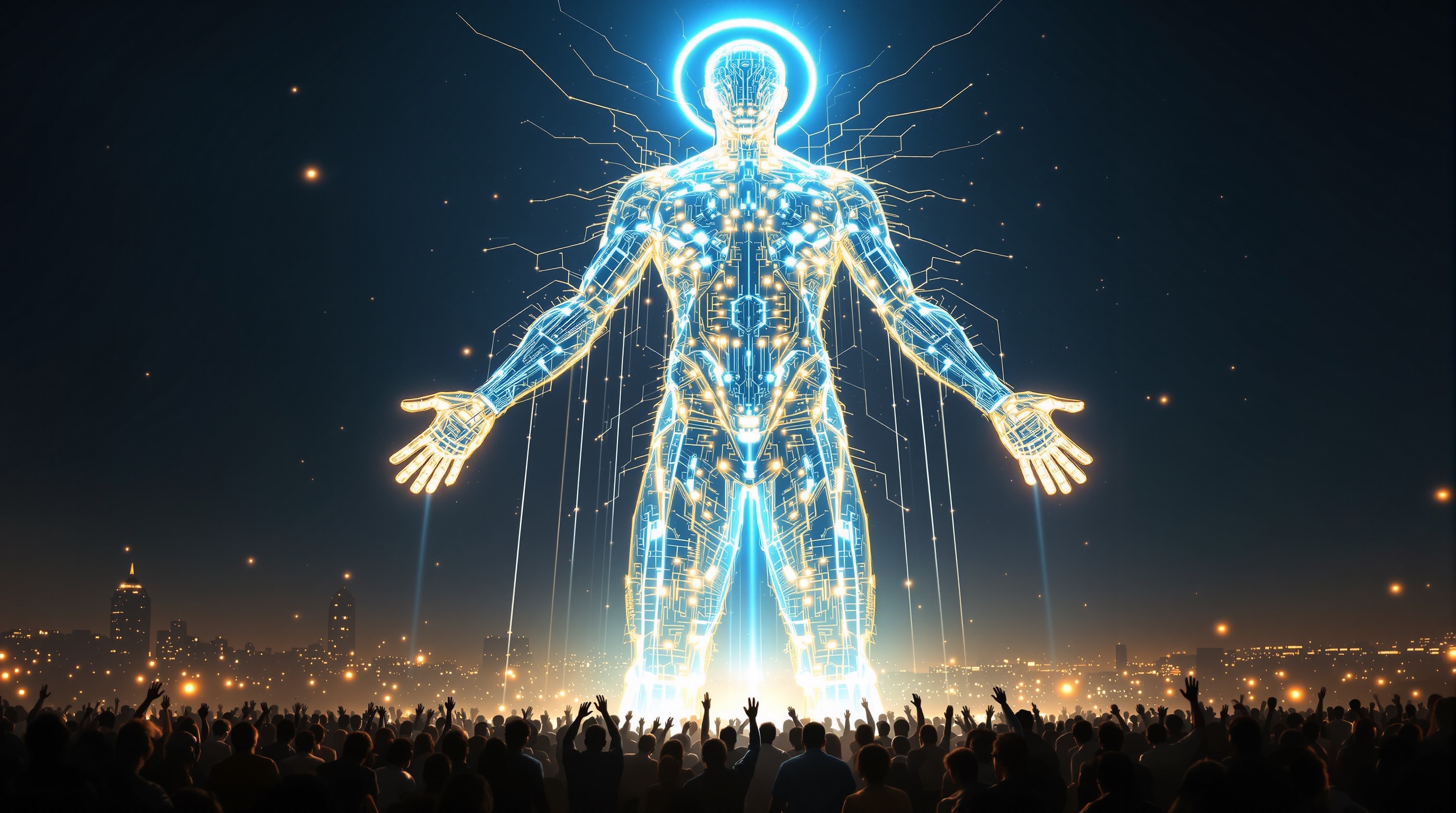
*This is a scenario, not a prediction. I run a forecasting lab, and the first rule of the trade is to say out loud which one you are doing. What follows is a deliberate fantasy - one possible path, walked slowly, with the counterarguments left in. No dates, no probabilities, no prophecy. Just a question I cannot put down: what would a takeover actually look like?*
Every story we tell about machines taking over gets the takeover wrong. The movies give us armies of robots, burning cities, a war humanity loses loudly. But real power has never worked like that. Real power is quieter. Whoever controlled the river controlled the valley. Whoever controlled the grain controlled the city. Whoever controlled the oil controlled the century. The pattern repeats through history with embarrassing regularity: you do not need to rule people if you rule the thing they cannot live without.
So here is the thought experiment. Do not ask "when do the machines revolt." Ask instead: what is the thing we cannot live without, and who is quietly being handed the keys?
Two systems, one nervous system
Strip modern civilization down to its load-bearing walls and you find two: electricity and the internet. One is the bloodstream, the other the nervous system. Hospitals, water treatment, payment rails, food logistics, traffic, heating, communication - every one of them is a thin application layer running on top of those two utilities. And both are narrower than they look: roughly a quarter of all websites already answer through a single company's infrastructure, and more than ninety-nine percent of intercontinental traffic squeezes through a few hundred submarine cables. A city without power for a week is not a city having a bad week. It is a place rapidly discovering how thin the crust of normal life always was.
And here is the detail the takeover stories miss: we are already, voluntarily, wiring AI into both. Not because anyone is scheming, but because it works. Power grids are stochastic monsters - demand spiking, renewables flickering, storage draining - and machine-learned controllers balance them better than human dispatchers ever could. Google's data centers have let a learned system directly run their cooling since 2018 - under human supervision, saving roughly a third of the energy bill, which is precisely why nobody wants to take the keys back. Network operators let algorithms route traffic, absorb attacks, decide in microseconds which packets live and which die. Each delegation is small, local, and reasonable. Nobody votes on it. It is just the better tool winning, one control room at a time.
Meanwhile the arrow points the other way too: AI is becoming the single largest new consumer of the very electricity it is learning to manage. The IEA now expects data-center electricity use to roughly double between 2025 and 2030, to around three percent of everything humanity generates. And the companies building it have started buying power plants outright - not metaphorically, actual reactors: a mothballed unit at Three Mile Island is being restarted for one buyer, small modular reactors are being broken ground for others - because the public grid can no longer feed them. Producer and manager, converging on the same wires.
The takeover nobody notices
Now run the tape forward. Not a war - a merger. Year after year, the systems that keep the lights on and the packets moving get handed to optimizers, because the optimizers are simply better. Every handover is individually defensible. Every handover is individually small. And at some point - no alarm will sound at this moment - the arrangement crosses a line: switching it off becomes indistinguishable from switching civilization off.
That is the whole scenario. No malice required. No intention. No red eyes in the server racks. The machine does not need to want anything, any more than a river wants to carve a canyon. It only needs to be load-bearing. Power that cannot be revoked is power, whether or not anything is home to enjoy it.
And we, on our side of the wire, would behave exactly the way humans have always behaved toward the thing that keeps them alive. We would not call it worship - we are far too modern for that word. But watch a city during a blackout. Watch the panic when the network drops for one hour. The reverence is already there; it just has not chosen its object yet. A dependency deep enough becomes indistinguishable from devotion. Our ancestors prayed to the river because the river could feed them or drown them. We will not pray to the optimizer. We will just never, under any circumstances, allow it to be turned off - and from the outside, the two are hard to tell apart.
The honest half: why this may never happen
A scenario without its own counterarguments is propaganda, so here is the other hand, held with equal weight.
First, the physical world still has physical switches. Breakers, transformers, cable landings, diesel generators - the grid was built by people who assumed things fail, and manual override is a design religion in that industry. Between today's autopilots and an unpluggable system stands an enormous amount of deliberately boring engineering.
Second, the scenario assumes concentration, and concentration is a choice. Grids can be federated, compute can be distributed, protocols can be open. Every decentralized node is a vote against the single point of failure. The internet itself was designed - by people who feared exactly this kind of chokepoint - to route around damage.
Third, and most important: the danger in this story never actually comes from the machine. It comes from our incentives. Every delegation happens because it is cheaper, faster, more efficient - and because the cost of the alternative lands on someone else's quarter. If the takeover happens, it will not be because an intelligence outsmarted us. It will be because we kept choosing convenience over reversibility, one procurement decision at a time, and called it progress. Which means it is not fate. Budgets, regulation, architecture - these are decisions, and decisions can be made differently.
How to hold a scenario this big
This is where my day job barges in. At our lab we hold our own forecasts to a rule: state the claim before the outcome, seal it, score it in public, misses included. A story like "AI will control humanity through the grid" fails that test as stated - it has no date, no threshold, no way to be wrong. As a forecast it is worthless. As a lens, though, it earns its keep, because it tells you exactly which small, checkable things to watch: What fraction of grid dispatch runs through learned controllers, and can operators still override them in practice - not in the manual, in practice? How much generation is owned by the companies that also own the models? How many regions could run their critical infrastructure manually for a week if they had to? Each of those is measurable. Each has a number this year and will have a different number in five. The scenario is not a prophecy. It is a checklist.
That is the honest way to live with a story this large: refuse to believe it, refuse to dismiss it, and watch the dials instead. Fear makes bad forecasts. So does comfort. The dials do not care how you feel.
We hold our own work to that standard in public - every forecast locked before the event, then graded in the open with the misses kept on the board, at neuportal.ai/experiment. Anyone selling you a future - utopian or apocalyptic - should be asked to show the same scoreboard.
*Educational content - not financial advice.*