*This is an educational piece, not financial advice, and I am not a licensed adviser. Where I give a figure I attribute it; where I look to 2035 I am guessing, and I say so. The one thing I will not do is tell you what to buy.*
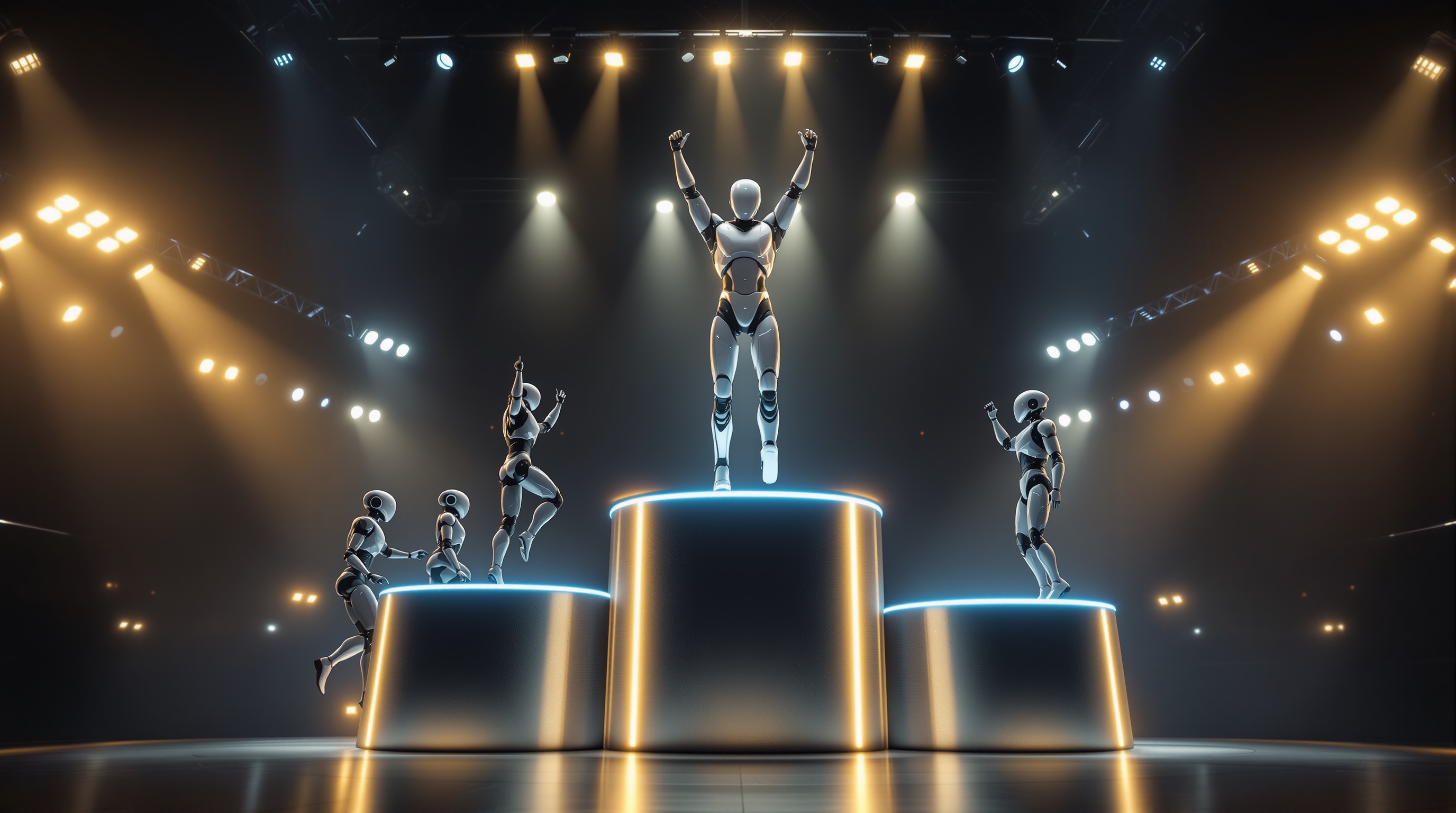
Picture a podium with a lot of robots climbing it. A few are near the top, arms up. Most are still scrambling on the lower steps. And the whole structure is being built, right now, out of something like three-quarters of a trillion dollars a year. That is roughly what the largest cloud companies are spending on AI infrastructure in 2026, and it is heading past a trillion in 2027. The race for first place in artificial intelligence is the most expensive contest in the history of business.
The question everyone is really asking - is it worth investing in AI - hides a harder one. Not "is AI real." It obviously is. The harder question is whether the money already spent will ever be matched by the money AI actually earns. Hold that thought, because it is the whole story.
Who is actually winning right now
Two races are running at once, and they are not the same race.
The first is the public one, the "AI trade" you can buy on any exchange. Nvidia sits at the top, worth somewhere around 5.4 trillion dollars as I write this - the most valuable company in the world, the first ever to touch that mark. Its data-centre revenue grew more than ninety percent year over year, which matters: that is not a promise, it is hardware people already paid for. Behind it are the giants building the data centres - Alphabet near four trillion, Microsoft in the mid-threes, Amazon around three, Meta near one and a half. None of them, except Nvidia, break out a clean "AI revenue" line, which tells you something about how hard the number is to pin down.
The second race is private, and it is stranger. OpenAI raised at roughly 852 billion dollars in March. Anthropic then raised at about 965 billion in May and passed it - the largest private venture round on record. Both describe revenue growing at speeds that have no real precedent. Both also filed quiet paperwork toward going public. And here is the first honesty flag: the two of them publicly argued about how one of them counts revenue - gross versus net - which is a polite way of saying that even the headline numbers in this race are contested. Treat every private run-rate you read, mine included, as reported, not audited.
Then there is the outlier that tells you how weird 2026 got: SpaceX bought the AI coding company Cursor for sixty billion dollars in all stock, the largest startup acquisition ever, and folded it in beside xAI, which SpaceX had already absorbed in February. One company now does rockets, an AI lab, a social network and a code editor. That is the shape of the top of this podium - enormous, concentrated and moving fast.
The one number that explains the whole race
Here is the figure I would tack to the fridge. A Sequoia partner framed it as "AI's 600 billion dollar question": the estimated annual gap between what the industry is spending on AI infrastructure and what AI is bringing in as revenue. Through 2026 that gap has reportedly been widening, not closing.
Sit with that. The spending is certain - you can see it in Nvidia's audited sales and in the cloud giants' own capital budgets. The return is not. One widely cited study found that around ninety-five percent of enterprise generative-AI deployments produced no measurable impact on profit or loss. A 2026 survey of chief executives found a majority - about fifty-six percent - saw neither higher revenue nor lower costs from AI in the prior year. Only a small minority saw both.
None of that means AI does not work. It means the money and the payoff have not met yet. Every valuation in this article, public and private, is a bet that they eventually will.
How big could this get by 2035
This is the part people want a number for, so here is the honest version: nobody knows, and the estimates disagree by enormous margins, mostly because they are measuring different things.
For the market today, one research house puts it near 390 billion dollars, another near 750, another near 260. That two-to-three-times spread is not a mystery - it is the difference between counting "generative AI only," "all AI software," and "AI's contribution to the wider economy." By 2030 you will see everything from a 1.2 trillion dollar market to a 15.7 trillion dollar figure - and that last one, the famous PwC number, is an estimate of AI's boost to global GDP first published back in 2017, not a company-revenue forecast. They get quoted as if they were the same thing. They are not.
Push it to 2035 and the ground gets softer still. The largest 2035 figure I could source with any confidence - around four trillion dollars - rests essentially on a single firm extrapolating a growth rate forward a decade. I will use it, but I will not pretend it is more than one educated line on a chart. If the last three years taught markets anything, it is that a straight line drawn through a boom is the least reliable object in finance.
So: could the AI market be several trillion dollars by 2035? Plausibly, yes. Is that a fact? No. It is a scenario, and the honest word for a scenario is "maybe."
The bull case, stated fairly
I do not want to strawman the optimists, because the strongest version of their case is genuinely strong.
The revenue ramps are real and, in places, unprecedented - a code company going from half a billion to several billion in annual revenue inside a year is not a rounding error. Nvidia's ninety-percent data-centre growth is hard demand you can audit. When five of the most disciplined companies on earth choose to spend seven-to-nine hundred billion dollars in a single year, that is not hype; that is management teams voting with cash on what they believe is coming. And the long-run productivity prizes that analysts describe - trillions in economic value - are large enough that even a fraction would justify a lot of today's prices. If the payoff arrives, the people who bought the picks and shovels early will look very smart.
The bear case, stated fairly
The pessimists are not luddites either, and their case is specific.
Start with that 600 billion dollar gap and the ninety-five percent of pilots that changed nothing on the bottom line. Add the circular financing that makes the demand look bigger than it is - a chip maker investing tens of billions into a customer who then spends it on that same chip maker's chips. Add what happened to everyone who is not a frontier lab: enterprise software valuations compressed hard through 2026, with the typical multiple falling by roughly half in a little over a year, as AI turned yesterday's premium products into commodities. Add price wars among the labs themselves, each cutting what it charges for intelligence, which is wonderful for users and brutal for margins. And note that a transformative technology and a good investment are not the same thing: the internet was real, and Cisco still fell more than eighty percent after 2000 and took some fifteen years to get back. Being right about the technology told you nothing about the entry price.
The uncomfortable truth is that both cases can be true at once. AI can change the world and still be a bubble at today's prices. History is full of both happening together.
What "investing in AI" actually means for you
If you take one practical thing from this, take this: you may already be more invested in AI than you realise, and in a shape you did not choose.
The handful of companies driving the AI trade - the so-called Magnificent Seven - now make up more than thirty percent of the entire S&P 500, somewhere around a third by mid-2026. Eight years ago that figure was closer to twelve percent. So if you own a plain index fund, you are already holding a large, concentrated bet on a few AI-exposed names, whether you meant to or not. "Diversified" does not mean what it used to.
Going deeper - trying to own the private labs directly - is harder and riskier than it sounds. OpenAI, Anthropic and the rest are not on an exchange. Retail access comes mostly through special vehicles with markups, lockups, opaque pricing and no promise you can ever sell when you want to. The numbers you would be buying on are, as we covered, self-reported and sometimes disputed. That is a lot of trust to extend to a chart.
I am not going to convert any of this into "buy" or "avoid." That genuinely depends on things I do not know about you - your horizon, what you already own, what you could afford to lose. Anyone who gives you a confident answer to "should I invest in AI" without knowing those things is selling something.
The honest bottom line
Here is where I land, and it is a way of thinking rather than a recommendation.
The technology is real. The leaders are real. The revenue, in places, is real. And none of that settles the only question that matters for a buyer, which is price versus what you are actually getting. The single thing I would keep watching is that gap - the distance between what the industry spends on AI and what AI earns. If it starts closing, the bulls were early and right. If it keeps widening, a lot of today's valuations are stories waiting to be repriced. As of now the independent evidence leans toward the gap, and honesty means saying that out loud even in a piece that is otherwise full of staggering growth.
That is the same discipline we hold ourselves to in our own small corner of this. We build AI agents that make forecasts, and instead of asking anyone to trust the pitch, we seal every forecast and timestamp it onto Bitcoin before the event, then score it in public afterwards with the misses left visible. The market for AI deserves the same treatment: not "trust the trillion-dollar story," but "show me the number, tell me the source, and admit what you cannot prove." You can watch us do exactly that at neuportal.ai/experiment.
The robots are still climbing the podium. Some of them will reach the top and be worth every dollar. Some are priced today as if they already have. Telling those two apart, before the fact and in public, is the entire game.
*Educational content - not financial advice.*